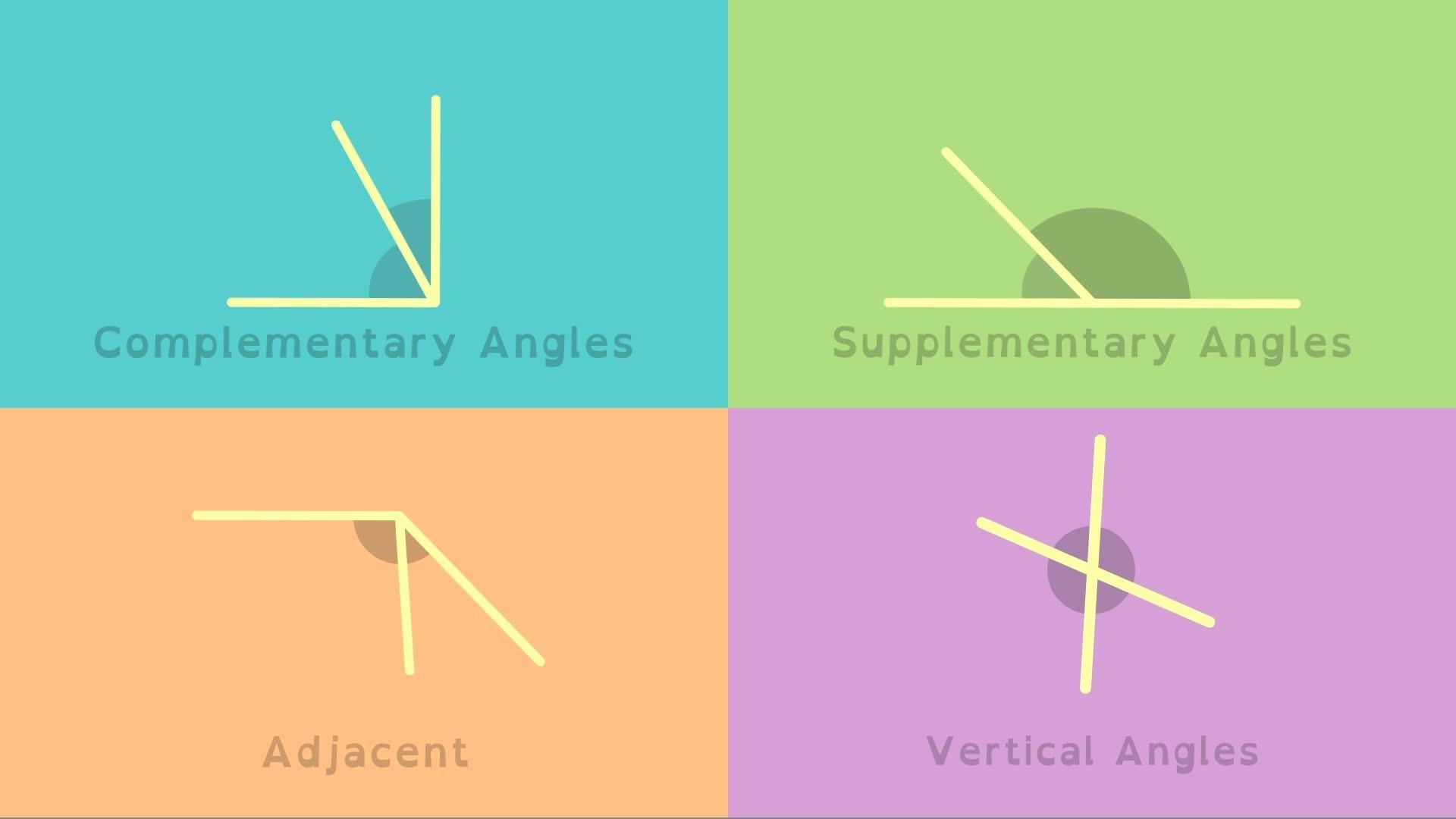
These angles aren't the most exciting things in geometry, but you have to be able to spot them in a diagram and know how to use the related theorems in proofs.
Complementary And Suplementary Angles. Identifying supplementary, complementary, and vertical angles. Two angles are complementary and supplementary angles if the sum of their measures is equal to 90 degrees and 180 degrees respectively.
Finding Unknown Angles Pbs Learningmedia from image.pbs.org
Angle x and angle y are adjacent angles because they share a ray (line in black) and a vertex (point in black called d). Given angles of 130° and 3°, determine if they are complementary or supplementary. This video describes complementary and supplementary angles with a few example problems.
Sometimes we group angles in pairs where they add up to either a right angle or a straight angle.
Consider these lessons as your handbook, textbook, guide, tutorials and (free of charge) home teacher. It contains word problems involving supplements and. Adjacent angles which sum to a right angle, straight angle, or full angle are special and are respectively called complementary, supplementary and explementary angles (see combine angle pairs below). Certain types of angles, known as complementary, supplementary, and vertical, are determined by the relationship to one another.